Glare is one of the most critical comfort criteria in lighting design. The Unified Glare Rating (UGR) quantifies the discomfort glare perceived by an observer in a room uniformly illuminated by identical luminaires. It is defined by CIE 117-1995 and extended by CIE 190:2010 into a standardised tabular method that produces catalogue values — the four numbers printed on every professional photometric datasheet.
eulumdat-ugr is a Python package
that computes the full UGR catalogue table from an EULUMDAT .ldt file,
conforming to the CIE 117 / CIE 190 methodology and validated against Relux and
DIALux reference outputs.
This package depends on
eulumdat-luminancefor luminance interpolation and projected-area calculation — see Computing luminance tables and polar diagrams from EULUMDAT files with Python.
For a field-by-field description of the EULUMDAT format and ISYM codes, see The EULUMDAT file format — a complete technical reference.
Installation
| |
Dependencies: eulumdat-py,
eulumdat-luminance ≥ 1.2.0,
numpy, scipy.
Quick start
| |
The UGR formula
The UGR formula (CIE 117, eq. 1) sums the glare contribution of every luminaire visible to the observer:
$$\text{UGR} = 8 \cdot \log_{10}\!\left(\frac{0.25}{L_b} \cdot \sum_i \frac{L_i^2 \cdot \omega_i}{p_i^2}\right)$$where:
| Symbol | Quantity |
|---|---|
| $L_b$ | Background luminance at the observer’s eye (cd/m²) |
| $L_i$ | Apparent luminance of luminaire $i$ as seen from the observer (cd/m²) |
| $\omega_i$ | Solid angle subtended by luminaire $i$ at the observer’s eye (sr) |
| $p_i$ | Guth position index — penalises luminaires closer to the line of sight |
Each of the three per-luminaire quantities ($L_i$, $\omega_i$, $p_i$) depends on the geometry between the observer and luminaire $i$, expressed as C-plane and $\gamma$-angle in the photometric coordinate system.
Apparent luminance $L_i$
$L_i$ is obtained by bilinear interpolation of the luminance table at the $(C_i, \gamma_i)$ direction from the observer to luminaire $i$:
$$L_i = L(C_i, \gamma_i) = \frac{I(C_i, \gamma_i)}{A_\text{proj}(C_i, \gamma_i)}$$where $I$ is the real luminous flux from the EULUMDAT header, and
$A_\text{proj}$ is the projected luminous area — both provided by
eulumdat-luminance.
Solid angle $\omega_i$
$$\omega_i = \frac{A_\text{proj}(C_i, \gamma_i)}{r_i^2}$$where $r_i^2 = R_i^2 + T_i^2 + H^2$ is the squared distance from the observer to luminaire $i$.
Guth position index $p_i$
$p_i$ is read from Table 4.1 of CIE 117 by bilinear interpolation on the ratios $H/R_i$ and $T/R_i$, where $H$ is the luminaire mounting height above the observer’s eye, $R_i$ is the horizontal distance along the line of sight, and $T_i$ is the perpendicular distance. The index amplifies the UGR contribution of luminaires near the line of sight ($p \approx 1$) and attenuates those far from it ($p \gg 1$). Luminaires with $T/R > 3$ or $\gamma > 85°$ are excluded from the sum entirely.
The catalogue method (CIE 190:2010)
CIE 190:2010 defines a set of standard conditions under which the UGR formula is evaluated to produce comparable catalogue values. The four catalogue entries correspond to two room proportions observed from two directions:
| Room | Observer looks along | Dimensions |
|---|---|---|
| 4H × 8H | Longitudinal (long axis) | 8 m × 16 m |
| 4H × 8H | Transversal (short axis) | 8 m × 16 m |
| 8H × 4H | Longitudinal (long axis) | 16 m × 8 m |
| 8H × 4H | Transversal (short axis) | 16 m × 8 m |
where $H = 2.0$ m is the mounting height above the observer’s eyes (fixed by CIE 190 §4.2, corresponding to luminaires at 3.2 m with eyes at 1.2 m from the floor). The observer stands on the mid-point of the short wall, at floor level.
Luminaire grid
Luminaires are arranged on a uniform rectangular grid with spacing:
$$S = \text{SHR} \times H = 0.25 \times 2.0 = 0.5 \text{ m}$$This gives 512 luminaires per room configuration. Positions are symmetric around the observer’s lateral axis, starting at $S/2$ from the observer’s wall along the line of sight.
Background luminance $L_b$
The background luminance at the observer’s eye is computed as (CIE 190, eq. 7):
$$L_b = \frac{E_\text{WID}}{\pi}, \qquad E_\text{WID} = B \cdot F_\text{UWID}$$$B$ is the average wall irradiance from direct flux:
$$B = \frac{\Phi_\text{real} \cdot N}{A_w}$$where $\Phi_\text{real}$ is the real luminous flux of the luminaire (first lamp set), $N$ is the number of luminaires, and $A_w = 2H(X+Y)$ is the wall area between the reference plane and the luminaire plane.
$F_\text{UWID}$ (CIE 190, eq. 8b) combines the downward flux distribution factors $F_\text{DF}$, $F_\text{DW}$, $F_\text{DC}$ — derived from the luminaire’s zonal flux — with room transfer factors $F_T$ that depend on room size and wall reflectances. The full table (5 reflectance combinations, 19 room sizes) is encoded from CIE 190 Tables 4 and 5.
Full output table
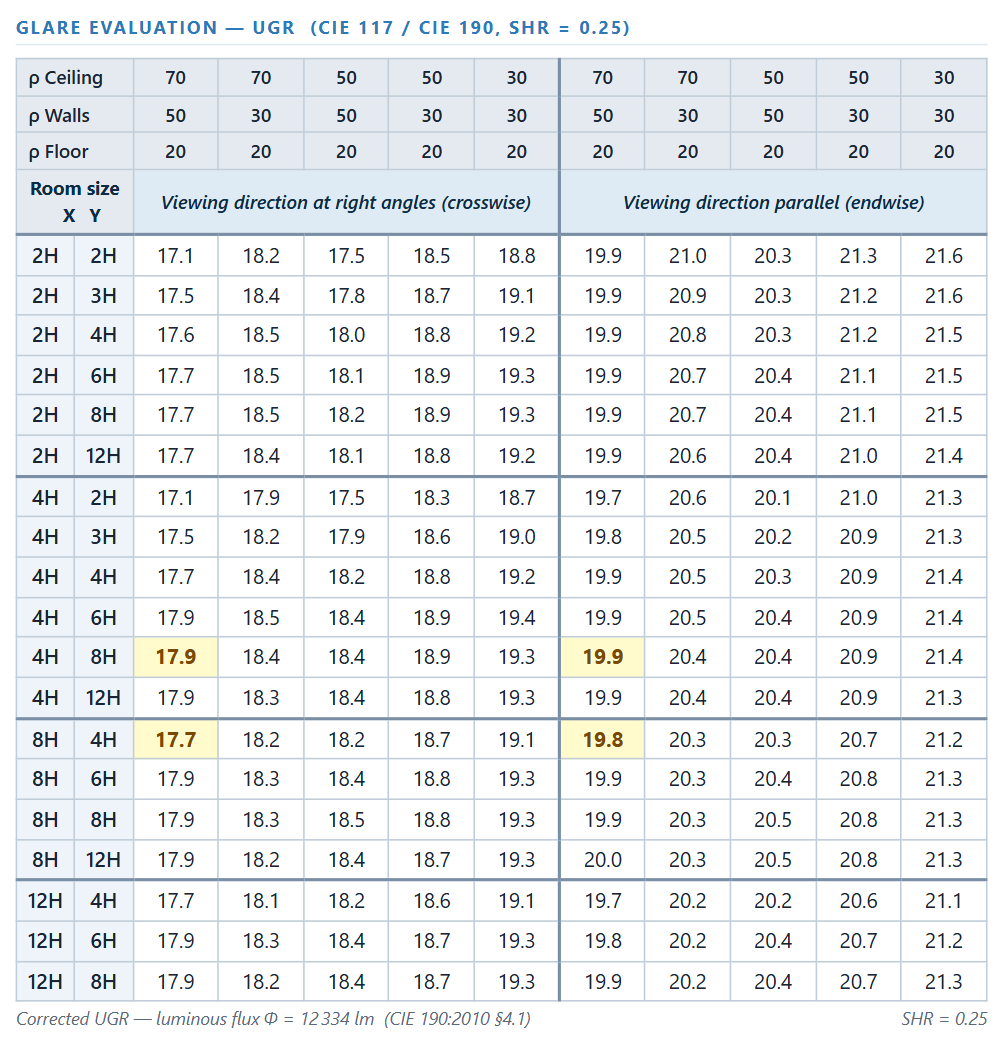
Beyond the four standard catalogue entries, the package computes UGR for all 19 room sizes defined in CIE 190 Table 3, covering room indices from $k = 0.6$ to $k = 5.0$. For each room, two observation directions and five reflectance combinations are evaluated:
| Reflectances (ceiling/wall/floor) | Common application |
|---|---|
| 70/50/20 | Standard office |
| 70/30/20 | Low-reflectance walls |
| 50/50/20 | Intermediate |
| 50/30/20 | Industrial |
| 30/30/20 | Dark environment |
The result is a $19 \times 10$ table (19 rooms × 2 directions × 5 reflectances = 190 UGR values), exportable as CSV or JSON.
Export
| |
The JSON output has three keys:
| |
Validation
The package was validated against Relux and DIALux on 11 representative LDT samples covering a range of luminaire types, sizes, and symmetry modes.
| Reference | Max deviation | Tolerance | Samples |
|---|---|---|---|
| Relux | 0.43 UGR | 0.5 UGR | 11 |
| DIALux | 1.01 UGR | 1.1 UGR | 11 |
The wider DIALux tolerance reflects a systematic inter-software bias: Relux and DIALux diverge by up to 0.8 UGR for small rooms ($k \leq 1.5$) and low reflectances (30/30/20). This bias is specific to DIALux and is not present in the CIE 190 standard. The implementation follows CIE 190:2010 and aligns with Relux (≤ 0.5 UGR); the DIALux tolerance of 1.1 = 0.8 (inter-software bias) + 0.5 (our residual vs. Relux) accounts for this.
The core algorithm was additionally verified against the worked example in CIE 190 (Table 8 and pages 20–22), confirming the zonal flux factors ($F_\text{DF}$, $F_\text{DW}$) and background luminance to within 0.2%.
Resources
eulumdat-ugron PyPI- Source code on GitHub
eulumdat-luminance— luminance tables and interpolationeulumdat-py— read/write EULUMDAT files- CIE 117-1995 — Discomfort glare in interior lighting
- CIE 190:2010 — Calculation and presentation of unified glare rating tables for indoor lighting luminaires